Whooping crane
Description
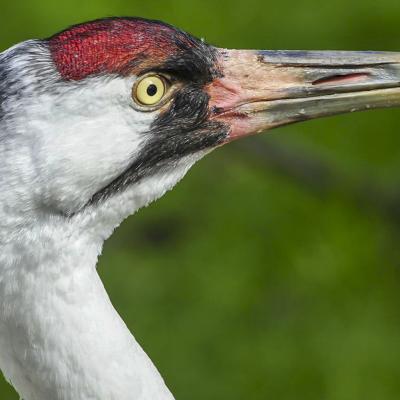
The Whooping Crane (Grus americana) is North America’s tallest bird, standing nearly five feet tall with a wingspan of seven to eight feet. Adults are bright white with black wingtips, long dark legs, and a red cap and face. Juveniles begin cinnamon-brown and gradually acquire mottled white plumage before reaching full adult coloration in their second summer. Whooping Cranes are long-lived and generally do not produce viable eggs until about four years old.
The species relies on shallow wetlands, marshes, and braided river channels for nesting, migration, and foraging. Their diet includes small fish, amphibians, crustaceans, insects, and plant material, as well as waste grain during migration. Severe habitat loss and unregulated hunting caused dramatic population declines in the early 20th century, leaving only a handful of birds. Intensive conservation efforts, including habitat protection, migration-route management, and coordinated recovery programs, have helped stabilize numbers, though the species remains one of North America’s most closely monitored endangered birds.
Overview
Status
Federally Endangered
Description
At nearly five feet tall, it’s North America’s tallest bird.
Habitats & Habits
Roosts on wide, shallow river channels during migration.
Distribution
Migrates 2,500 miles between Canada and the Texas coast.
Conservation Measures
Protected stopover sites along the Platte support its survival.
Life in Wetlands and Grasslands
Habitat and Habits
Whooping cranes are omnivorous feeders that forage on many items including mollusks, crustaceans, minnows, reptiles, amphibians, invertebrates, small mammals, small birds, berries, live oak, agricultural grains, and plant tubers located in wetlands, grasslands, and agricultural fields.
Whooping cranes are monogamous and form life-long pair bonds but will re-mate after the death of a mate. Whooping cranes return to the same breeding territory in Wood Buffalo National Park in April and nest in the same general area each year. The nesting area in Wood Buffalo National Park is a poorly drained region interspersed with numerous potholes. Bulrush is the dominant emergent in the potholes used for nesting.
Adult whooping cranes construct nests of bulrush and lay one to three eggs (usually two) in late April and early May. The incubation period is about 29 to 31 days and chicks fledge at about 60 to 70 days old. Whooping cranes will renest if the first clutch is lost or destroyed before mid-incubation. Both sexes share incubation and brood-rearing duties. Despite the fact that most pairs lay two eggs, sibling rivalry usually results in only one chick reaching fledging age. Approximately one-fourth of chicks that hatch survive to reach the wintering grounds.
On the wintering grounds, pairs and family groups occupy and defend territories. Sub-adults and unpaired adult whooping cranes form loose flocks that use the same habitat but remain outside of occupied territories where they first wintered. Sub-adults tend to winter in the area where they were raised their first year and paired cranes often locate their first winter territories near their parents' winter territory.

A whooping crane rests and forages in shallow wetland habitat.
Migration and Range
Distribution
Whooping cranes, which were listed as federally endangered in 1970, use the river in their spring and fall migrations. The U.S. Fish and Wildlife Service has designated the reach of the Central Platte River from Lexington to Shelton, Nebraska, as critical habitat for the whooping crane.
The whooping crane formerly nested from central Illinois west to eastern North Dakota and north through the Canadian prairie provinces. It presently breeds in Wood Buffalo National Park in the Northwest Territories, Canada. It overwinters on the Texas Gulf Coast on and in the vicinity of the Aransas National Wildlife Refuge. A second foster population migrates from Grays Lake National Wildlife Refuge in Idaho to the Bosque del Apache National Wildlife Refuge on the Rio Grande River in New Mexico. In South Dakota, the whooping crane is a predictable spring and fall migrant in the Missouri River drainage and in western South Dakota, with only occasional sightings in the eastern part of the state. This species does not breed in South Dakota.
Protecting a Species on the Brink
Conservation Measures
The whooping crane population, variously estimated at 500 to 1,400 individuals in 1870, declined to only 16 individuals in the migratory population by 1941 as a consequence of hunting and specimen collection, human disturbance, and conversion of the primary nesting habitat to hay, pastureland, and grain production. The current population numbers around 500 individuals. The whooping crane was listed as endangered on March 11, 1967.
The historic range of the whooping crane once extended from the Arctic coast south to central Mexico, and from Utah east to New Jersey, into South Carolina, Georgia, and Florida. The historic breeding range once extended across the north-central United States and in the Canadian provinces, Manitoba, Saskatchewan, and Alberta. Currently the main threat to whooping cranes in the wild appears to be the potential of a hurricane or contaminant spill destroying their wintering habitat on the Texas coast.

An adult whooping crane walks with its chick in shallow wetland habitat.