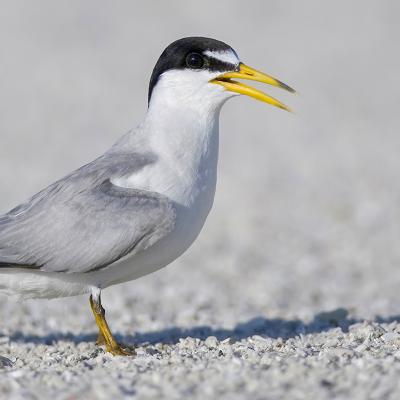
Interior Least Tern
Description
The Interior Least Tern (Sternula antillarum athalassos) is the smallest tern in North America, measuring 8 to 9 inches long with a 20-inch wingspan. Adults have a black cap, white forehead, pale gray upperparts, white underparts, and bright yellow legs and bill tipped in black. Immature birds are duller, with darker bills and buff-colored plumage. Agile in flight, the species hunts by hovering above shallow water before diving to capture small fish and aquatic invertebrates.
Interior Least Terns nest on open, sparsely vegetated sandbars, gravel flats, and riverine islands where visibility is high and predator approach is easily detected. Nests are simple scrapes in sand or gravel. Historically common along major interior rivers, the species declined sharply following channelization, reservoir construction, and the loss of natural sandbar habitat. Conservation actions, including flow management, habitat restoration, and protection of nesting colonies, remain essential to maintaining stable populations across their range.
Overview
Status
Federally delisted in 2021, but protected under the Migratory Bird Treaty Act and Nebraska’s Nongame and Endangered Species Conservation Act.
Description
North America’s smallest tern with quick flight and sharp, agile dives.
Habitats & Habits
Nests on open sandbars and feeds on small fish in shallow river waters.
Distribution
Breeds along central U.S. rivers and migrates to coastal wintering areas.
Conservation Measures
Protected sandbars and managed flows help maintain stable nesting habitat.
LIFE ON RIVER SANDBARS
Habitat and Habits
Least terns forage on small fish they capture by diving into shallow riverine habitats and freshwater ponds. Along the central Platte River, these birds usually feed within the river which is generally a short distance from their nesting colony. Least terns are a colonial nesting bird that mob predators or other intruders by dive-bombing and defecating on them. Throughout its range, least terns breed and nest on barren to sparsely vegetated riverine sandbars, sand and gravel pits, lake and reservoir shorelines, rooftops, ash pits, and salt flats from mid-May to early August. Along the central Platte River, least terns generally nest on managed off-channel nesting habitat created by sand and gravel mining operations or through excavation activities of the Program.
Least terns usually lay three eggs in a shallow scrape and may renest if their nest is destroyed. The nest is an inconspicuous, unlined scrape usually containing three brown spotted eggs. The incubation and brood rearing period for nests and chicks generally lasts from 38 to 50 days. Least tern chicks are not capable of foraging on their own so only a single brood is raised each year, as adults must continue to feed offspring for several weeks after fledging.

Least Tern guarding its beach nest.
Migration and Range
Distribution
Least terns are long-distance migrants that breed in North America and winter in Central and South America. The interior least tern historically nested along the Colorado (in Texas), Red, Rio Grande, Arkansas, Missouri, Ohio and Mississippi River systems. It currently nests in the Mississippi and Rio Grande River basins from Montana south to Texas and from eastern New Mexico and Colorado to Indiana and Louisiana.
SUPPORTING A RECOVERED SPECIES
Conservation Measures
The interior least tern was federally listed as endangered on June 27, 1985, primarily due to the loss of nesting habitat as a result of dramatic alterations (channelization and impoundment) of important river systems; however, a recently completed five-year review resulted in the February 12, 2021 delisting of the interior least tern due to recovery. The U.S. Fish and Wildlife Service is now in the process of putting in place a post-delisting monitoring plan to encourage and guide voluntary efforts to track species recovery. The Program will continue to manage for the interior least tern along the central Platte River in a manner consistent with ongoing piping plover management on habitat used by both species.
Reproductive success along the central Platte River depends greatly on creation and maintenance of off-channel nesting habitats and protection of nesting birds from disturbance and predation. Several methods have been used in an effort to deter humans, pets, and predators from nesting areas including fences, lighting, trapping, warning signs, and public information efforts.

A least tern chick blends into the sandy gravel.