Pallid Sturgeon
Description
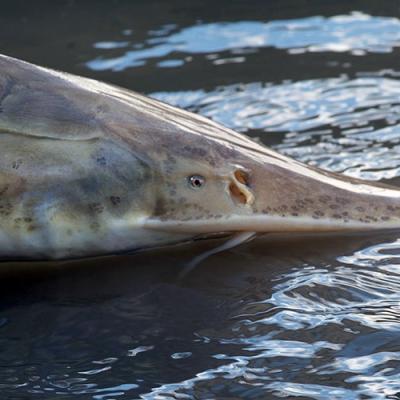
The pallid sturgeon (Scaphirhynchus albus) is one of the largest freshwater fish in North America, typically measuring 30 to 60 inches long and weighing up to 85 pounds. Although similar in appearance, the smaller shovelnose sturgeon rarely exceeds 5 pounds and is darker brown, while pallid sturgeon have pale grayish-white backs and sides. Younger pallid sturgeon can resemble adult shovelnose sturgeon, but pallid individuals turn noticeably whiter with age. Both species have heterocercal tails with a longer upper lobe, though this feature is more pronounced in pallid sturgeon.
Like other sturgeon, pallid sturgeon lack true bones and scales, instead possessing cartilaginous skeletons and five rows of thick bony plates that run along their sides, backs, and undersides. These plates, covered by skin, provide protective armor and contribute to the species’ ancient appearance. Additional cartilage extends from the dorsal fin to the tail, giving this endangered fish a distinctive, prehistoric profile adapted to life in large, turbid river systems.
Overview
Status
Federally Endangered
Description
A long-lived ancient river fish with a pale, armored body adapted for big rivers.
Habitats & Habits
Lives in large, turbid rivers and feeds along the river bottom.
Distribution
Native to the Missouri and Mississippi basins with limited Platte use.
Conservation Measures
Flow and habitat work help support this endangered river species.
LIFE ALONG THE RIVERBED
Habitat and Habits
The pallid sturgeon's mouth is located well back from the tip of the snout. Pallid sturgeon are generally bottom feeders, skimming the sandy reaches of the various rivers and streams in their habitat. Lacking teeth, they use their extendable mouths to suck up small fish, mollusks, and other food sources from river bottoms. Though little is known about the precise eating habits of the species, they are thought to be opportunistic feeders. One study which examined the contents from the stomachs of juvenile pallid sturgeon revealed that their diets were seasonally dependent. Various insects were consumed during some seasons and various fish species during others. These results support the description of the pallid sturgeon's eating habits as opportunistic.
Pallid sturgeon have a long lifespan, living in excess of 50 and perhaps as long as 100 years. They lack bones and scales, which makes it more difficult to establish their age and determine exactly how long they live. As is true for many long-lived species, pallid sturgeon reach reproductive maturity relatively late. Males reach sexual maturity between the ages of 5 and 7 years, while females are believed to become capable of reproduction when they are at least 15 years old. One study of nine females indicated that they begin egg development between the ages of 9 and 12 years, but do not reach reproductive maturity until they are 15 years old. Reproduction does not take place every year; the average interval between spawning is three years, although other studies suggest an interval as long as 10 years. Spawning usually takes place May to July. For several decades, no natural reproduction of pallid sturgeon was observed, since all the fish that had been captured were older specimens. In the late 1990s, young pallid sturgeon were discovered living in a restored riparian area of the lower Missouri River. This was the first documented example of wild spawned pallid sturgeon in 50 years.

Biologist holding a pallid sturgeon during river research.
RANGE ACROSS GREAT RIVER SYSTEMS
Distribution
The pallid sturgeon's historical range spanned the entire Missouri River and into the Mississippi River. Pallid sturgeon prefer moderate to swift river currents, turbid waterways, and water depths between 3 and 25 feet. The species is more commonly found where sandy substrates are plentiful, but also lives in predominately rocky waterways. In Nebraska, a small number of pallid sturgeon have been captured along the lower reaches of the Platte River. Unlike most rivers in the Mississippi-Missouri River System, the Platte River has only a few dams and they are well upstream from its confluence with the Missouri River. The lower Platte River is shallow with numerous sand bars and small islands. Though pallid sturgeon prefer more turbulent and deeper rivers than the Platte River, several pallid sturgeon, including some from hatcheries, have been captured from the Platte River. The lower reaches of the Platte River, a more than 30-mile stretch from the Elkhorn River to its confluence with the Missouri River, is believed to have suitable spawning habitat for pallid sturgeon, although no conclusive evidence has been found that successful spawning is occurring in this region. Along with the lower Yellowstone River, the lower Platte River was identified as one of the best of the remaining regions with the potential for natural spawning.
PROTECTING A RIVER GIANT
Conservation Measures
Though never believed to be common, pallid sturgeon populations rapidly declined during the late 20th century and the species was listed as endangered on September 6, 1990. The U.S. government and most of the states with pallid sturgeon populations have commenced restoration efforts to save the species from extinction. Wild reproduction of pallid sturgeon is rare to nonexistent in most areas; therefore, human intervention is needed to ensure the survival of the species. Pallid sturgeon were previously considered a prized trophy game fish species, until their numbers declined and they were placed on the endangered species list. All captured pallid sturgeon must now be released back to the wild.

A two-year-old pallid sturgeon shown in a close-up underwater profile.